The mark of any really solid explanation is how incredibly obvious it seems in hindsight.
Exhibit A comes via John Willshire’s latest newsletter, where he talks about how he came to understand why it might be that writing stuff on “robust, considered and permanent” cards (rather than the usual post-its) and moving them around a lot seems to unlock ideas so successfully.
He got his realisation from a 2013 talk by John Wood on what the latter called The Creative Quartet. Take it away, Mister Willshire:
John Wood’s explanation of The Creative Quartet was based on the work people do together. If two people bring an idea to the table, then can find one synergy between those two ideas. But if another two people bring ideas to, then there aren’t just two synergies, or even four, but six.
At the time I first saw [Wood’s four-person diagram], I clearly remember thinking ‘oh, that’s what’s happening with cards’.
If you have two ideas on separate cards, you can find one opportunity for combining them. And add another two cards, and all of a sudden you have six different combinations available.
And the maths magic doesn’t stop there. Add another four cards, and you’ll have a total of 28 possible two-card combinations. Add another four cards again, to make a total of just 12, and then you have 66 possible combinations. The secret of course, is developing methods and mechanics to keep shuffling those ideas around.
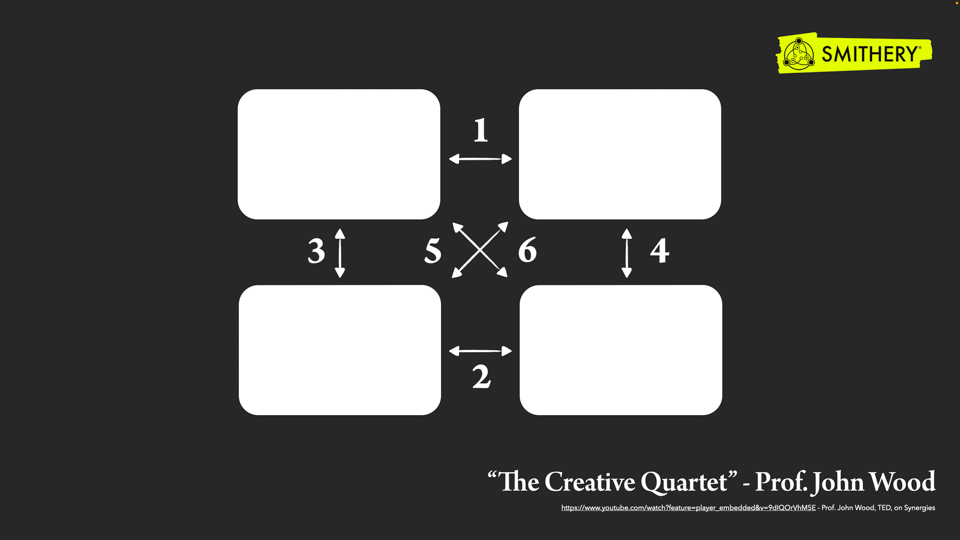
My revelation, in turn, came from reading the above and thinking “oh, this is also how tarot cards work”.
That revelation applies to two different modes of deployment. First of all, there’s the more free-form way I use the tarot for fiction generation (and indeed for other non-fictional forms of writing), which often involves moving a few random picks around until a particular relationship of juxtaposition just kind of “pops”. This is pretty close to what John’s talking about, I think.
Secondly, there’s the more traditional divinatory approach, whereby the cards are dealt out into a “spread”, in which each position has a particular relationship to the question at hand. In this case you’re not moving the cards around—or at least, it’s unusual to do so—but that flexibility is compensated for by a stable yet complex network of pre-determined angles on the issue under exploration. John focusses on the number of possible two-card combos, but in a serious tarot spread, you might be looking at three, five or even ten cards in combination (if not still more).
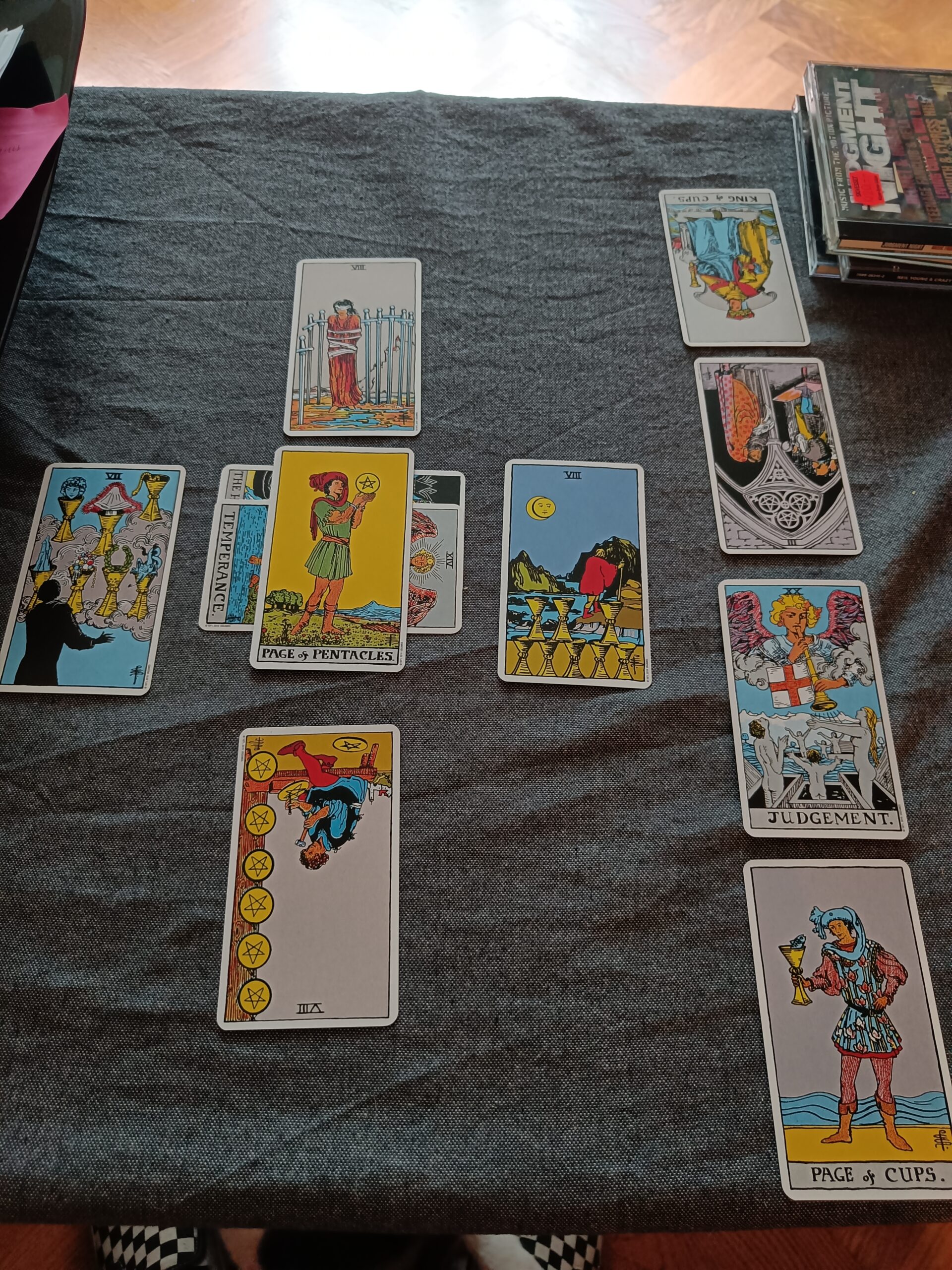
The better class of tarot practitioner (for which my benchmark will probably always be the much-missed Rachel Pollack) will be at pains to point out that while a reading starts from interpreting each card in the context of its position in the spread, and of the position in the spread to the question or topic at hand, there is a sort of emergent, high-level reading that comes with experience, where extra information is found in connections and echoes and oppositions that emerge between and across the various positions in the spread.
If my maths is right, the number of different combinations of relationships between positions the classic ten-card “celtic cross” spread shown above is 3,628,000. My maths is inadequate to the task of working out how many different combinations are possible when each of those positions can hold any one of the 78 unique cards in a standard tarot pack, but I feel that the admittedly qualitative answer “A LOT” gets us into an appropriate ballpark.
“More stories than there are stars in the sky,” one might even say.
Sitting with even those guessed and approximate numbers is humbling, but also kind of spooky. Anyone who has used the tarot a bit will be able to tell you about the way certain cards have a habit of turning up repeatedly in the same positions when reading for a particular person, or even across readings for many different people; the numbers emphasise just how extraordinarily unlikely that is, if you’re being properly diligent about randomising the deck.
Pollack mentions in one of her books that a lot of practitioners claimed to have had a real rash of The Tower popping up in readings in the weeks ahead of 11 September 2001; you can believe that or not, as you prefer. I do know that when I keep getting the same card appearing across repeated readings for others, I’ve learned to assume that card’s message is as much for me as for whoever I’m reading for.
Leave a Reply