I am probably going to regret this, but nonetheless I want to put this thing out there myself rather than leaving it to some reactionary troll from the fringes to make it all about them. Perhaps a veteran who fought on the winning side of the Blog Wars (in however minor and likely ineffectual a role) might actually merit a hearing on this point—always assuming, of course, that anyone in fandom and/or the sff biz still reads this shabby old blog. So, here goes:
Jonathan Strahan’s new Le Guin tribute anthology has a zero-man TOC.
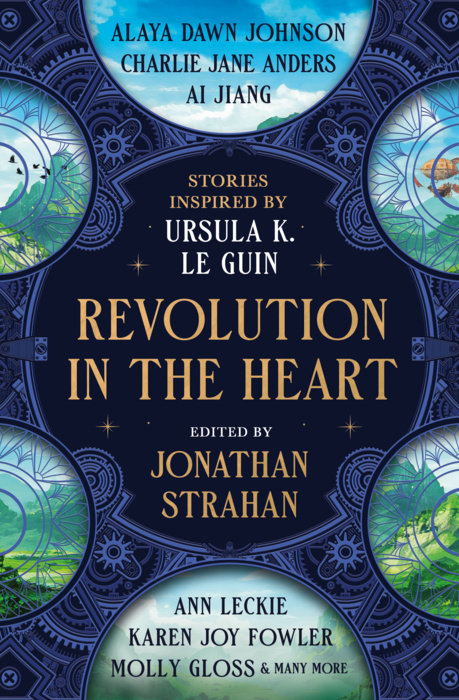
Let’s try to head a few things off at the pass by being very clear about what I’m not doing here.
This is not a beef about quality. I’ve bought the book, I intend to read it, and I fully expect I’ll probably like it. It’s an anthology of short fiction and, even while Strahan has a pretty decent hit-rate in this household, it is in the nature of anthologies that there’ll be two or three tent-pole marvels, a bunch of fairly good stories and a scattering of stinkers. That’s to be expected, and has no bearing on this discussion. For our purposes here, the stories don’t actually matter.
For that reason and others, I am not beefing with any of the authors appearing in the book, either. Congrats on the sale!
Nor am I exercising some sort of personal sense of snub. As an extremely minor author, I am very aware of my level with regard to both quality and profile, and on neither count would I ever be a candidate for a book of this magnitude, unless perhaps it were devoted to a very specific niche.
This shouldn’t be taken as an attack on Strahan, either, who is by all accounts a thoroughly decent sort, and who like any sff antho editor is doing it primarily for the love (because you’d sure as shit be mad to do it for the money). That said, the choices made here, conscious or otherwise, were presumably mostly Strahan’s—but really what I’m doing is making this book a synecdoche for the sff scene as a whole.
Which brings us to what this is: firstly, an observation that we have here a major anthology from a leading editor out of one of the bigger imprints in the scene, which has zero male authors represented on its TOC; and secondly, a good faith attempt to think through how that might have happened, and what it might be taken to mean about sff in 2026.
I used the word “represented” in that last paragraph advisedly, because representation is what we were once all at war about, back in the day.
I don’t recall exactly how many blog posts there must have been that took great pains to point out that it wasn’t about exclusivity or quality; the point was that people of all ethnicities and genders read sff, and write the stuff too, and that an all- or majority-male TOC, in addition to reflecting poorly on its curator, was a none-too-subtle signal to those unrepresented categories that they weren’t really welcome, that the genres weren’t really meant for them.
So, what’s the signal here? Does that argument no longer hold when the boot is on the other foot? If we could say back then that an all-male TOC said something not just about that anthology, but about the culture of sff more generally—and, let’s be honest: we did say that, and we said it repeatedly, and I believe that we were right to do so—then surely we should be able to say the same of a zero-male TOC, and ask what values are being expressed thereby?
Let’s first think a little bit about how this might have happened. I’m not going to be super-exhaustive about this, not least because I don’t think it necessary to belabour my point overmuch in an era when writing little tick-list pieces about the problem with “manels” at industry shindigs is apparently still very much a thing. (Besides, you all remember the standard questions for this sort of post, I’m sure—so feel free to add your favourites if I miss them!)
The first possibility is the easiest to discard, namely that of sheer statistical accident. Given maybe two decades of intense public scrutiny of TOCs for gender distribution, I find it impossible to imagine that an editor of Strahan’s experience and savvy simply didn’t notice that he’d not picked any male authors; answer dismissed.
The second possibility is that the anthology is perhaps oriented toward “women’s issues” (yeah, yeah, I know) and therefore not really suited to showcasing a male perspective. However, Strahan’s very brief intro makes no such claim, orienting the stories only in retrospect as fulfilling Le Guin’s justly famed and well-quoted call for artists who could take on the hard times she saw coming. One might, I suppose, argue that an antho in tribute to Le Guin could be implicitly a women’s-issues book, or at the very least a not-a-dude’s-issues book… but it would seem strange to keep such a framing on the downlow if it were actually in play, even were the anthologist an unknown quantity lacking Strahan’s track record of sense and sensibility. (Furthermore, it would also be something of an insult to both Le Guin’s fiction and her philosophy to slap the “women’s issues” label on an antho in her honour. She was definitely interested in representation and stereotypes, and in the redress of earlier shortcomings in that regard; but her fiction was about—and was aimed at—humans being, without category.) And so, again: answer dismissed.
Thirdly, perhaps there were simply no qualified male authors available for the gig, or in the editor’s rolodex? The latter is risible—few editors are better connected these days than Strahan, if any, as his earlier books indicate very clearly. The former is also pretty silly, though I think it merits a longer look once we get to the matter of meaning; as such, I’ll come back to it in a bit, despite having concluded that this third explanation holds very little more water than the previous two.
And so, as always tends to happen when one tilts at a sock-puppet synecdoche like this, Occam’s razor leaves us with one plausible, simple answer, which is that a leading anthology editor and their publisher both looked at a zero-man TOC and thought “yup, that’ll do it”.
It was a choice.
Having addressed the question of how we got the zero-man TOC, I now want to turn to the question of what it might be taken to mean. I’m going to start by returning to one of my dismissed explanations, namely “no qualified man available”, because I think of all the abandoned explanations, it’s actually by far the most plausible. That’s a pretty low bar, admittedly, but bear with me—because there’s really not a lot of men publishing short sff these days, are there, apart from the usual suspects from previous generations? I’m sure the younger men trying, though! But maybe the men are just not writing what editors are looking for? Maybe they’re just (whisper it) not very good? Maybe the ones who are good enough just weren’t right for this particular antho? Maybe none of them know or care about Le Guin’s work?
All eminently reasonable answers, to be clear! (Well, except the last one, which is simply insane. You can hardly move for people of any and every gender and ethnicity celebrating Le Guin for her contribution to not just the genre but literature in general, and rightly so: assuming we get a future deep enough, she will be have a stature comparable to Shakespeare.)
But nonetheless it’s notable that the axe seems reliably to be falling to one side of the corridor, in this antho and elsewhere. Either questions of taste and quality are somehow consistently selecting against male authors, or the number of submissions from men is so low that it just looks that way, or it has simply become acceptable to overlook an entire gender from consideration because, well, let’s be real: who’s gonna miss ‘em?
It is my belief that the actual situation results from a melange of those three possibilities—though I should note that I really don’t think anyone is consciously thinking the last one out loud in the way I just portrayed it. Sure makes it sound nasty, though, doesn’t it, when you suggest it might be a deliberate thing, as opposed to being a cultural norm that has gone unquestioned for a long while?
I have also left out the one excuse which I think is very consciously in play, but which I will simply no longer countenance, and that is the argument for redress: you know, “the dudes can take a step back while we give a little extra platform to everyone else, just to even things up a bit.”
As I have noted elsewhere, it is still a shibboleth—including in critical venues staffed by people smart enough to know better—to talk of sff as some enduring sausage-fest wasteland of puerile horndoggery, reactionary fight-songs and quasi-porn, and poorly-disguised paeans to the colonial imperative.
This is, to be very blunt, utter bullshit. It has been bullshit for some time now, too. Look at the shelves in the bookstores; look at the bestseller lists; look at the TOCS and mastheads of the surviving short fiction venues.
You won. You won a long time ago. I invite you to recognise and acknowledge that fact, and to consider how you have governed in the wake of that victory.
For the avoidance of any doubt, I’m not waxing nostalgic for the days of all-dude publishing; I’m just wondering what happened to the ideal of representation that I fought for, alongside many others, back in the Blog Wars.
Only I’m not actually wondering that at all—because what has happened is what has always happened, historically speaking, in sff as in any other outsider-identifying subculture with a sufficiently sizeable commercial concern attached to it: a new generation arises, grows restless in the shadow of its out-of-touch elders and rulers, and storms the citadel! Triumphant, its first task is always to fix the portcullis, restock the moat with fresh alligators, and generally consolidate the gains.
Each generation is a turn of the wheel, a mote in the tao’s teardrop swelling suddenly to fullness, but never fully pushing aside that which it comes to replace—never fully defeating that in opposition to which it has, often unknowingly, defined itself. As Nietzsche noted, it is the fate of those who hunt monsters to become, if only in part, that which they sought to destroy.
Those who fight fire with fire serve only to sustain the conflict. This is taoist dogma, and it is everywhere in Le Guin’s work.
Truth be told, though, I’m not sure the wheel will ever turn again in quite the same way. The pivot to cosiness—whose clear correlation with the unmanning of the genres is perhaps not indicative of causation, but which in such case surely begs an alternative explanation?—may in fact mark the passing into obsolescence of the genre once known as science fiction. John Clute buried “the old sf” back in the Noughties, and the “new sf” he heralded at the same time—in which “the reward for saying ‘yes’” was no longer “the future”, but rather “death”—seems mostly have to run its course, with what energy still remains running to ground through the New Weird (a subgenre which, it bears noting, does seem to skew rather male).
I, for one, have zero desire to see that boosterish C20th “old sf” return—and I rather doubt we will, because production of such naive technological utopias has largely passed to Silicon Valley, which has done more to discredit and banalise them than the critical shock-troops of fandom ever managed. (Hey, we tried, you know?) The internal contrarian threads of “the old sf”, meanwhile—most notably cyberpunk, I suppose, but also maybe space opera as now encountered in e.g. Games Workshop properties and the seemingly interminable extruded product of the Star Wars franchise—have long since escaped the generic containment field to leak into the wider culture, where they have become tropes with astonishingly wide recognition and popularity.
The baby which we lost with that bathwater would be the Ballard-descended sort of science fiction: social, psychological and largely Bound to earth (again, in the Clutean sense); unflinching, yet at the same time far from unafraid; literary and experimental in its stylistic aspirations. Again, the ghost of this thread lives on in the New Weird (or whatever the descendents of that subgenre, disavowed by almost everyone ever tagged with it, may end up being shelved as): Mike Harrison, Miéville, Vandermeer, Nina Allan, Matt Hill, Lincoln Michel, and surely a significant bunch of small-press others of whom I’m simply not yet aware, because (as I must finally accept) I’ve been looking too long for wild animals within the confines of a petting zoo.
What we think of as “sff publishing” isn’t really carrying much of this stuff, and much of the true speculative thunder has in the last decade or so been stolen by literary authors who, when they’re not reinventing the wheel in painfully embarrassing ways, are actually starting to do some really interesting work with it.
The conditions that allowed literary sf to arise—relatively widespread literacy; print as a popular and affordable mass medium; &c &c—no longer pertain. That contrarian energy will surface somewhere else, I’m sure, because it’s the energy that turns the wheel. But I think that the other thing I want you to accept—and this may actually be the harder pill to swallow of the two—is that sff is no longer an outsider or contrarian genre.
Indeed, it hasn’t been so for quite some time, but the full extent of its domestication is utterly inescapable at this point: the bestseller lists tell the whole story, and I’m not about to synopsise it. You can certainly protest otherwise on the basis of specific examples, if you like, but you’re merely recapitulating the old snobbish distinction once made between “ess eff” and “skiffy”; “my elves are different,” as the old webcomic used to have it.
The merging of romance tropes with sff is indicative in this case. I have no beef with romance per se; as a writer and a former library employee, I’m always happy when people are finding books they enjoy. But I am both baffled and amused by recent attempts to reclaim romance as countercultural, rebellious, feminist, leftist! Romance is, pretty much by definition, a genre of wish-fulfilment and happy-ever-after. And that’s fine; nothing wrong with wanting some sort of escape or imaginary world in which things go your way, especially in the hard times that Le Guin flagged in that famous speech.
However, romance in the generic sense of the term is a long way from the “realism of a larger reality” that she called for at the same time—and I find the refusal to accept and to own that yearning for comfort to be telling, because it speaks to the superficiality of the war-footing radicalism that sff fandom and publishing still like to claim. For all the much-discussed shortcomings of second- and third-wave feminisms, I still think that their most fierce proponents within the genre world—Tiptree; Russ; Butler; Jones; Atwood; and, yes, Le Guin—would be justly aghast at a generic culture arguing in the name of radical feminism for exactly the domesticities and platitudes that were once clearly understood and lampooned as patriarchy’s pay-offs to a quiescent, liberalised womankind.
But what would I know about feminism in sf? After all, I’m just a man—and you wouldn’t ask a man to write in response to, or in celebration of, the work of a feminist author, would you? That would be ridiculous!
Joking aside, I think that this recent essay at LARB railing against the cozification of queer sf is an example of a similar call to this one, but coming from inside the house, so to speak. It further suggests that there’s a whole other angle yet to be taken in the discussion of identity and representation, in order to ask what happens when achieving it turns out actually to undermine one’s sense of outsiderdom and specialness: how to reconcile one’s desire to be treated as normal with the commercialised normalisation of one’s very desires? File under “be careful what you wish for”, I guess—and maybe cross-reference with “capital inevitably recuperates and monetises any and all critique”.
But that’s not my discussion to lead, nor perhaps even in which to participate. Instead, I took to my soapbox to ask a representational question to which my own identity surely entitles me, and which precedent surely justifies: how did we end up with a zero-man anthology TOC, and what we might take it to mean in the context of genre publishing in 2026?
My conclusion is that we got that TOC because the relevant decision-makers figured it was fine, and I take that to mean that the cycle is now complete: the victorious insurgents have finally and fully become, if you’ll excuse the phrase, The Man.
Leave a Reply