Author: PGR
-
“Man-made, artificial, mutable” — Dunne (2005), (In)human Factors
Chapter 2: (In)Human Factors (pp. 21-42) from Dunne, A. (2005). Hertzian Tales: Electronic Products, Aesthetic Experience, and Critical Design. MIT Press. # Paradigm of user-friendly design generates “enslavement […] to the conceptual models, values and systems of thought the machines embody” (p21) “By poeticizing the distance between people and electronic objects, sensitive skepticism must be…
-
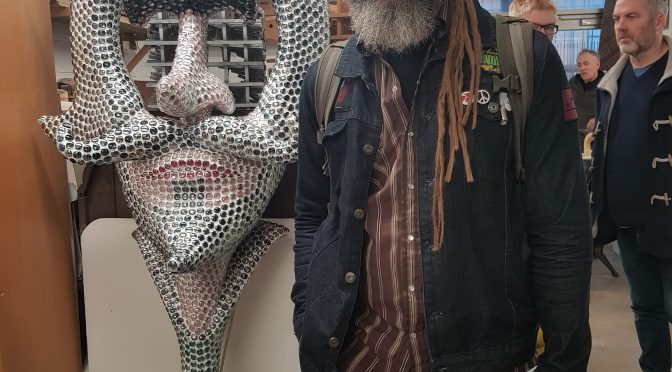
Face-off
Spent Sunday afternoon walking around Persistence Works on their annual open-studio day; lots of sculptors and silversmiths, some furniture-makers, painters, print-makers, mosaicists. Super building, too; gorgeous raw concrete, great views. Not sure what this thing was all about, if I’m honest (it’s a David Allsopp), but the resemblance was much remarked upon.
-
There is no them
The champions of peace will always be vulnerable to the argument that since the enemy, too, is whetting his knife, talk of peace is unrealistic, even dangerous or treacherous. The quest for peace, like the struggle to arrest climate change, requires that we think of ourselves not just as states, tribes, or nations, but as…
-
Notes toward an MFA creative writing module
INTERVIEWER: Do you really think creative writing can be taught? VONNEGUT: About the same way golf can be taught. A pro can point out obvious flaws in your swing. And somewhat less flippantly: VONNEGUT: I guarantee you that no modern story scheme, even plotlessness, will give a reader genuine satisfaction, unless one of those old-fashioned…
-
Distort some central part of the present condition
Some wisdom from Uncle Warren: TCJ: I talked to a sci-fi editor at Tor in late 2016 about dystopias and their popularity in eras fraught with political disaster, and he said something that stuck out to me: “I think one of the underrated reasons that people read science fiction in particular is that it’s a…