I’ve been rather remiss with the accessions posts of late, but I’m not gonna go back and catch up.
Nor am I going to include unremarkable acquisitions, like the trio of second-hand peak-era Rolling Stones CDs that I picked up at the weekend. There’s no smart reason for my doing so; I just never had copies of them before, and as such have never listened to them as albums—which is to say as they’d have been listened to when they were released—rather than as the commercial radio goldies or early-evening alternative-club floor-fillers that they were to me in the Nineties.
(I did not grow up in the sort of household that listened to the Rolling Stones, nor even the Beatles for that matter—unless perhaps Terry Wogan was playing one of the latter’s early, safe pop songs on Radio 2 of a morning.)
These two are worth talking about, though:
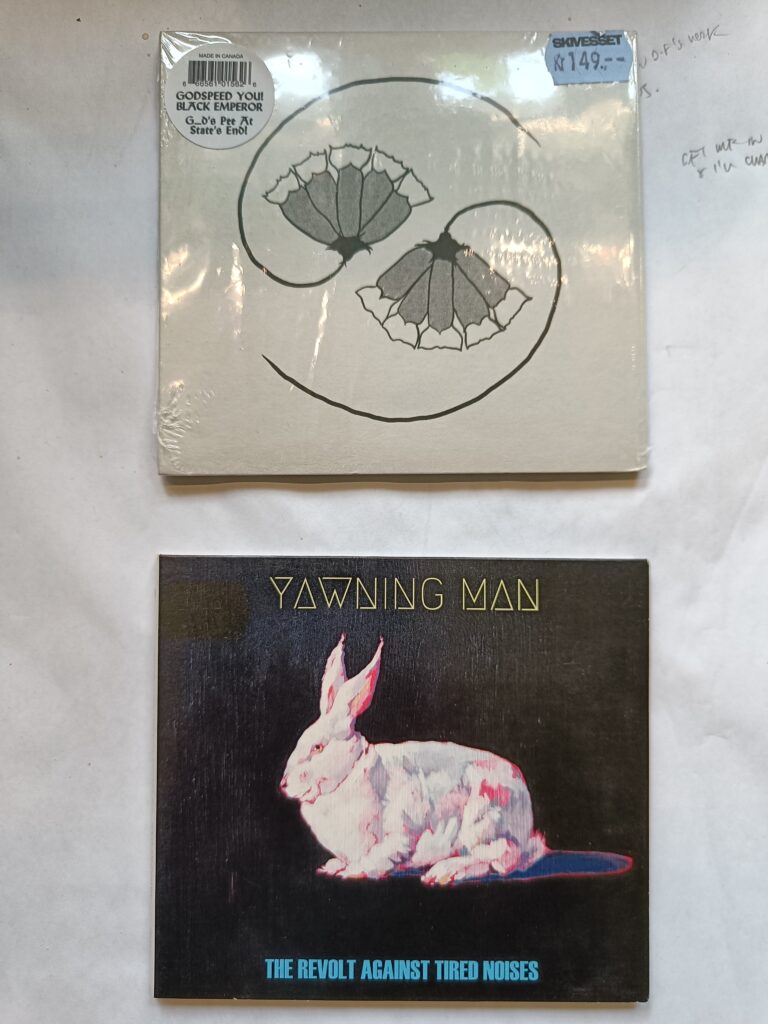
G_d’s Pee at State’s End by Godspeed You! Black Emperor: I got into Godspeed because some enlightened soul had accessioned Lift Up Your Skinny Fists… to Portsmouth City Library Service around the time I started working there, and I’ve done my best to follow their work ever since. I saw them play the Academy in Manchester in (I think?) 2010, which was a fantastic show, with the exception of the drunk idiots talking loudly through the quiet bits. I’ll be seeing them again in Copenhagen in the middle of next month, and I’m guessing that the wood panelling of Vega is going to make for some pretty spectacular acoustics.
If you know Godspeed already, nothing about this album would surprise you, and if you like them already, everything about it will delight you; they never sound like anything other than themselves. Usually (and not at all unreasonably) filed under “postrock”, they’re outliers even in that outlier of a genre: quasi-anonymous Canadian anarchists making soaringly beautiful cracked laments for the edgelands of late-late capitalism. The sort of band I always hoped I might one day be a member of, if I’m honest.
The Revolt Against Tired Noises by Yawning Man: L____ is quite an enthusiast of Yawning Man, but it was a while before I realised that they are basically the lesser-known last-man-standing of the desert rock scene best known for spawning Kyuss. (Indeed, this album features a version of “Catamaran” from Kyuss’s … and the Circus Leaves Town, which was in turn a cover of a tune that featured in Yawning Man live sets back in the day.) I knew YM were still active, as I seem to recall L____ saying she’d been to see them play locally, but I didn’t know they were still releasing; … Tired Noises is a 2018 album, apparently?
Less heavy than the Kyuss-adjacent heritage might lead you to expect: think slow, echo-drenched USian psyche-rock, played in the power trio format, and devoid of the other group’s reflexive (and, with hindsight, rather wearisome) irony and pastiche. But both bands had a knack for catching the wide-open-skies vibe of the landscape in which they threw their now legendary generator parties—and decades later, this album could be a soundtrack to a long solo wander among the dusty cacti, looking back from time to time at the town you set off from and wondering what it all means.
On the topic of listening to albums as albums: Damon Krukowski went to see the authorised biopic Becoming Led Zeppelin (as did I), and has some interesting thoughts regarding not only Jimmy Page’s choice to own and control their music from the get-go, but also to reject the single as a format, aiming instead for the then-emerging FM radio phenomenon in the US, where it was commonplace for a station to play an entire side of an LP without interruption, back-announce it, splice in an ad, and then play the other side in much the same way.
It’s a reminder that when we talk of music as a medium—be it rock or pop or whatever genre—we are talking about much more than just the medium in which the recording might be bought, accessed and listened: we are talking about the entire infrastructure of production, of promotion, of distribution and recompense. These are shaping forces, sometimes directly affecting the sound or content of the music itself, but more often directing the form of it, in ways that are easy to miss.
When one talks of a palpable difference in music in the 2020s compared to the 1960s, or even to the 1990s, one stands accused of fogeyism, rockism, and all the other -isms that aren’t the reigning one. Nonetheless, there is a difference—and it goes further than the superficial issues of style and instrumentation. Popular music was already being rapidly commodified when Led Zeppelin were coming up, and it’s to Page’s credit that he recognised that and met it head on—but that sort of wiggle room still existed then, because the medium was not an integrated vertical as it is now.
(Indeed, poptimism’s obsession with surface might best be understood as a refusal to engage with precisely these infrastructural issues.)
Anyway, Krukowski’s piece is well worth a read—and the film’s worth seeing, too, if you’re at all connected to the heritage of hard rock.
Leave a Reply