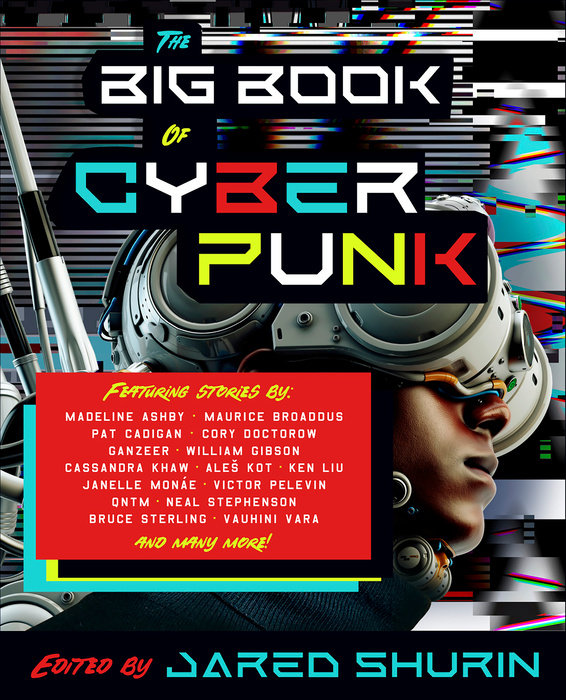
The ToC dropped last week, so I figure I can safely announce that I have a story in Jared Shurin’s Big Book of Cyberpunk, the USian edition of which is released on September 24th, with a UK edition to follow some time next year.
“Los Piratas del Mar de Plastico” was commissioned by Chairman Bruce for the 2014 Twelve Tomorrows antho from MIT Press, which was surprise enough, but Gardner Dozois picked it up for his annual Best Of the following year. And now this!
File under “unexpected accolades”, I guess—though as I noted on Mastodon last week, the surprise has long since worn off, as Jared got in touch to secure the rights to the story about a year ago; the wheels of publishing grind sloooowly.
I suppose this also means that I no longer get to hem and haw over whether I write (or at least have written) cyberpunk, even if here I’m bundled in the “post-” subgenre. But as time goes by, and as I do more reading and research toward another (and currently rather nebulous) project, I’m less worried about that label: the current pop-critical narrative around cyberpunk, which seems to want to paint it as an uncritical celebration of neoliberal capitalism, bears very little relation to what the OG cyberpunks were about, or even the ways in which those early ideas and aesthetics went on to shape our current sociotechnical milieu. In other words—and rather ironically—it has become a punchbag for the prevailing paradigm, much as the straw-man of “prog rock” became a punchbag for the punk movement.
But that punchbagging marked a period in which punk was rapidly becoming a derivative parody of itself… and while the postpunk explosion didn’t exactly embrace prog aesthetics, it did make a point of jettisoning the dogmatic strictures of the increasingly plastic and self-parodic punk scene. I’m overstretching the metaphor a lot, here—business at usual at VCTB, innit?—but perhaps cyberpunk is less like punk and more like goth: a stubbornly enduring and misunderstood subgeneric approach, roundly mocked by whoever’s at the fashionable forefront, but always outliving them all.
Eh, whatever. Point is, we can argue about the labels until the cows come home—and we can have a lot of fun doing it, too—but behind the labels are some great works of literature. That one of my stories has somehow slipped under the velvet rope and gatecrashed this particular gathering is something I’ll always be very proud of.
Leave a Reply