There can be weeks after weeks in which a daily tarot reading seems to say very little of obvious import. While this worried me at first with the implication that I might be doing something wrong or not analysing hard enough, I’ve come to assume that it’s more like meteorology: when the weather isn’t changing, you’re not going to see the dial of the barometer moving very much.
Such periods also serve to underscore the sudden arrival of what can only be interpreted as far stronger signals. If after weeks of ambivalent spreads you get the same card coming through three days running, it’s hard to avoid the sense that something big is coming down the pipe.
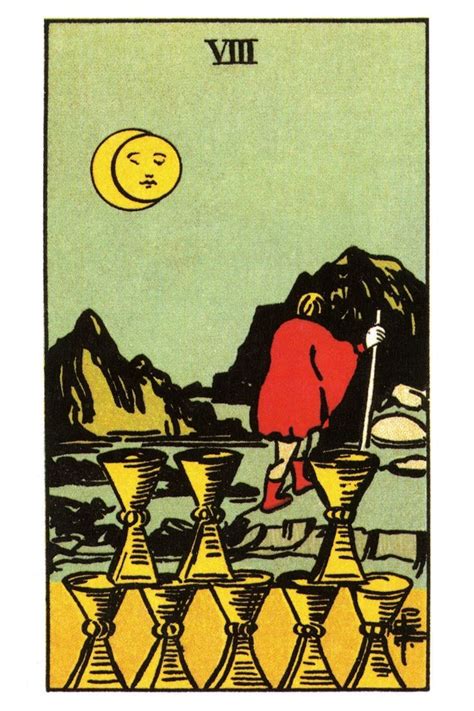
The card in question is the eight of cups, whose meaning in my own personal system of pithy summaries is basically “party’s over”. In her earlier work, Rachel Pollack said that the eight is actually about leaving a stable situation before it falls apart—and it’s worth noting that none of the cups depicted in the Waite/Smith card have fallen over, as they have in the more obviously tragic five of the same suit. That said, I can never help but notice that the pattern of their arrangement in the eight implies that one of them is absent; perhaps it is under the cloak of the figure walking away from us?
Pollack sees that figure as the hermit-in-waiting, heading for the hills in recognition that, while the party may not yet be over for everyone, it is high time that they personally make a move toward a solitary and isolated quest for knowledge and meaning. The eighth sephira is HOD, the sphere of magic and language and the intellect, where Mercury dwells; cups, meanwhile, are the suit of water, the yin principle. Submission and yielding are thus doubly indicated here—and also passivity, though not in the crude and derogatory sense that word has in daily usage. Rather, it’s the passivity of the tao, which flows around and away from hardness and obstacles, on its inevitable way to the “low, dark places”.
Which contradicts, it might seem, with the implication that the eight is the hermit in waiting, per Pollack—for does not the hermit head for the higher ground, as he appears to be doing here, under the uncanny light of an eclipse? But height may be figurative as well as literal… and in the context of yin, of water and of the tao, those “low, dark places” are the heights of submission and passivity, both of which qualities are very much of a part with the archetype of the hermit.
Interpreting so strong a message is in many ways even harder than interpreting a far weaker one, particularly in the context of a personal daily reading. With a signal so loud, one has to consider the possibility that it is coming from (and/or referential to) the contextual macrocosmic world, rather than the subjective microcosm of the self—and seen that way, the “party’s over, head for the hills” message could have pretty drastic implications, to say the least. (Put it this way: were I the type of person to own shares on the stock market, I’d be thinking very hard about selling today.)
In this particular case, however, I think it’s more about certain personal decisions and actions of the last few days, and in particular a validation of said decisions; this is a rather more comforting interpretation.
That said, it bears noting that both interpretations could be valid at once without any contradiction.
Leave a Reply